

Dogs vary greatly from one another, and so do their sleeping habits. A lot has already been written about the different sleeping positions dogs adopt, and the fact is that the position a dog sleeps in can reveal something about their overall wellbeing. Perhaps the sleeping position even holds the key to some mysterious behaviour in your dog that nothing else seems to explain.
A well-rested and refreshed dog is a happy dog, ready for new challenges and to tackle various situations. Dogs have the same sleep pattern as humans, made up of several stages: (1) light sleep, (2) deep sleep, and (3) the REM stage, characterised by rapid eye movement under closed eyelids. Unlike humans, who sleep through around 4 to 5 90-minute cycles per night, dogs go through 20 or even more sleep cycles, each lasting only about 15 minutes. For this reason, puppies need more sleep to get enough rest.
In some sleeping positions, your puppy might not even reach all three stages important for good sleep, which is why it's all the more important to understand your puppy's sleeping habits and help them if necessary. When understanding sleeping positions as indicators of your puppy's well-being, we observe an adult dog; puppies haven't yet developed their own habits and discovered what suits them best, while older dogs may be forced into a certain position due to stiffness and pain.
To better understand what your dog is telling you with its sleep, we have gathered the thoughts of veterinarians and professional trainers, as well as research findings, and divided them into the 7 most common sleeping positions below:

I'll rest my head
Some dogs enjoy sleeping with their neck and head resting on an elevated surface, such as the edge of a bolster bed or a pillow. In this position, the head is pointed straight (not to the side) and rests on a surface, not on their front paws (in this case, see the “sphinx” pose). If your dog likes to sleep with its head elevated, it may indicate that they have difficulty breathing properly – something that usually occurs with chronic heart disease and other health problems, and with certain dog breeds that have disproportionately short heads and muzzles: Pugs, French Bulldogs, English Bulldogs, etc. However, the cause of such a sleeping position could also be an unsuitable bed that forces the dog into an unnatural posture. The bed might be too small, have too much of a dip, or be surrounded by bolsters (a nest) in which the dog cannot fully stretch out, even though this is their favourite way to sleep. You can also read about choosing the right bed here.

I curl up into a ball
In this position, the dog sleeps curled up in a ball, with their paws and tail tucked close to the body. Sometimes the nose touches the hind legs in a 'shrimp' shape, and dogs can even curl up completely, wrapping their tail over their body. This sleeping position is very typical of dogs going through the process of settling into a new home, and usually means they feel anxious or feel the need to protect their body. When a dog only sleeps in this position occasionally, they're likely feeling cold and trying to conserve body heat, which is common during autumn and winter. During this time, make sure your dog stays warm, and in addition to a comfortable bed, provide an extra blanket and cushion. Another possible cause of this sleeping position is a nest-style bed that's too small, or a crate that's too small for the bed placed inside it. To avoid forcing your dog into an unnatural sleeping position, always choose the right bed size, and by observing your dog's sleeping habits, also the right bed shape.

I am on guard like a lion statue
In this position, the dog rests its head on its front paws. This is generally not a sign of deep sleep, but rather a state of readiness for action. These are usually daytime naps taken when the dog is on watch (for example, by the front door). This is typical of devoted and loyal dogs who protect their surroundings and family. If your dog often adopts this position during the day, provide a mat or faux fur (especially in winter) in the places where it rests. Lying on cold floors can lead to health problems such as bone and joint pain, and bladder infections are also a risk. If the surface is too warm for the dog, it will move away and find a cooler spot. A dog may also begin its nighttime sleep in this position; it may lie like this for a while before settling into a more comfortable position to relax. If your dog maintains this position all night and exhibits accompanying behavioural issues, it is best to visit or call your vet to ask for advice on how to help your dog get a proper rest. The least you can do is provide your dog with mattress, that offers proper support, and place it in a spot where your dog doesn't have a view of what's going on, so they can settle down and rest from their dedication to guard duty.
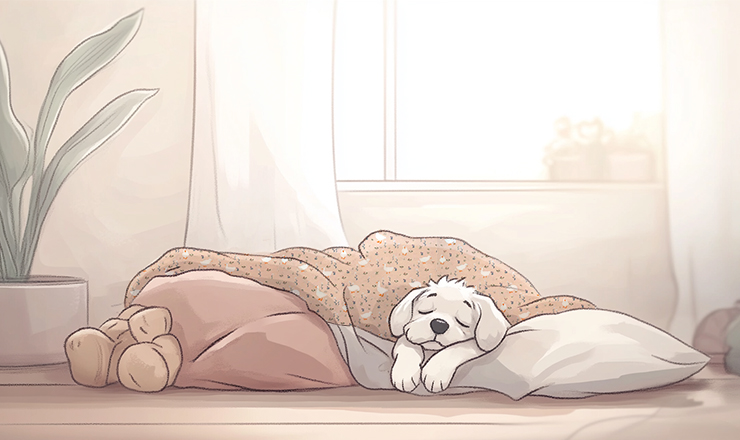
I bury myself up to my neck
If you notice that your dog loves burrowing into cushions, blankets, toys, clothing… then you have a little mole at home who needs a sense of protection, security and warmth. This kind of behaviour may also suggest that your dog wants to calm down and withdraw, minimising light and sound from their surroundings so they can rest properly. With this kind of behaviour, it's important to observe what's happening throughout the day and ease whatever is causing your dog stress. Either way, make sure to provide plenty of props with which it will cover itself, it will bury itself in. In our shop you can find duvets and pillows with soft anti-bacterial filling.
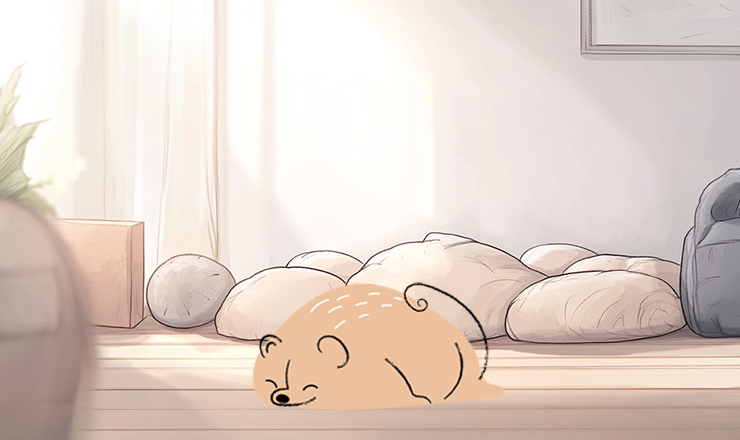
I'm pressing my stomach to the floor.
Whether lying face down on the tiles inside or sprawled out on the patio, puppies typically sleep on a cool surface when they're hot. This type of position can have variations, but they all share the common trait of having their belly, which is the least furry part of their body, touching a cool surface. If you notice your puppy lounging like this, make sure they have access to cool water with some ice cubes added, or help them cool down faster with some tasty frozen treats. Here you will find recipes for the best ice cream treats.
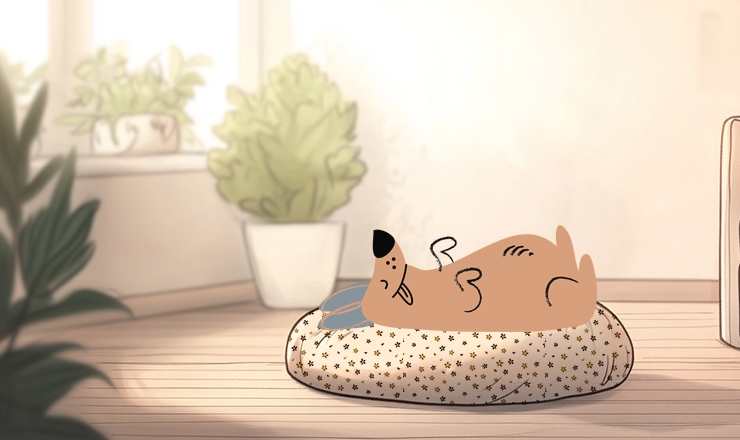
Paws up in the air
One of the cutest sleeping positions is on its back with its paws sticking up in the air. In this position, the dog exposes all its organs and limbs, and the position also doesn't allow for a quick get-up in case of danger, which is a sign of your dog's true comfort and complete relaxation. If the dog happens to fall into a deep sleep in this position, then all the better. If the dog's face twitches and its paws move uncontrollably, you'll know it's in a deep sleep. With this position, you can be sure that your dog feels great in your home and lacks for nothing.
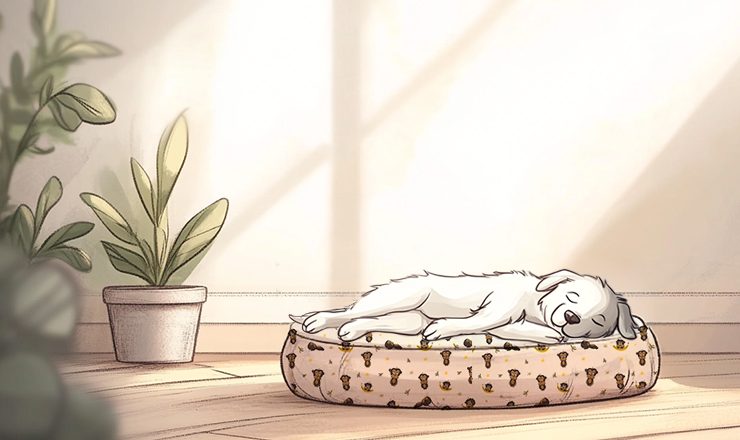
Left side, right side, sleeping like a log
A very common position for puppies and older dogs, but in our opinion, a winning position for adult dogs too. When a puppy lies on its left or right side with its paws stretched out, it tells us that it is at the right temperature, completely relaxed, and very likely in a deep sleep. If the paws are not extended at first, when the puppy is still preparing for sleep, they probably will be once it has completely relaxed and got used to the position. Because the puppy is in a position where it is not protecting its vital body parts, it feels good in its environment and trusts it. This is the position where you will most often see your puppy unconsciously moving its paws, groaning, twitching, and wrinkling its nose, meaning it is dreaming or processing data, which is characteristic of deep sleep. Those who enjoy this position are usually able to rest anywhere, but they prefer their own bed. If your puppy falls asleep in this position even when other, unfamiliar people are nearby (for example, in a restaurant or shop), it means that it trusts you completely, is confident because of you, and generally has good experiences. In addition to a permanent bed for such a puppy, offer it another spot near you (kitchen, work area, terrace) for daytime rest, such as a rug or blanket, that are relevant in the colder months. Otherwise, congratulations on forging such a strong bond with your puppy!
If you haven't found a position among the listed ones in which your pup sleeps and rests, don't worry. Explore further and we'll be happy if you share with us your discoveries and attach a photograph of a yet undiscovered sleeping position. Just like you, your dog is a unique creature that develops its own habits and pleasures. Your puppy is no exception when it comes to the following: it loves your attention, adores cuddling and enjoys indulging in its comfortable bed.