
About us
Why was the BF bed created
Sleep for dogs is not merely a time for rest. It is an important part of their daily physical and psychological balance. During sleep, the body restores energy, the nervous system processes information and experiences, and the brain plays an important role in consolidating learning and memory.
Dogs spend a large part of their day sleeping or resting, so the quality of their rest is closely linked to their everyday well-being. Too little or frequently disturbed sleep can affect mood, the ability to manage stress, concentration and behaviour. Quality rest also enables the dog to recover more easily and be more balanced throughout the day.
It is also important, where and how the dog sleeps. Just as people change position while sleeping, turning, stretching out or curling up, a dog also needs the opportunity to freely change its body position while resting. Appropriate body support, enough space and a quiet environment are therefore not just a matter of comfort, but part of a quality rest.
And it was precisely this line of thought that gave rise to the story of Bonaparte Fortuné: to create a bed that wouldn't just be beautiful, but would first be thoughtfully designed around what a dog truly needs while resting.
From idea to design
When we started exploring the importance of sleep in dogs, we found that this area is still surprisingly under-researched. At the same time, we noticed an interesting phenomenon on the market: Nest-like beds are often presented as a synonym for safety, comfort and a sense of shelter. Such a shape can of course be pleasant for some dogs and give them a sense of security.
And while thinking about quality rest, we asked ourselves something else:
Is the feeling of shelter really the only or most important need for a dog while sleeping?
Dogs naturally shift positions while resting, turning, curling up, stretching out and curling up again. Their space requirements also vary depending on their size, age, body shape and sleeping style.
That is why we wanted to look at the dog bed from a slightly different perspective. What kind of bed would a dog actually choose in nature? Why do owners often say: ‘We bought him beds, but our dog prefers the floor’.
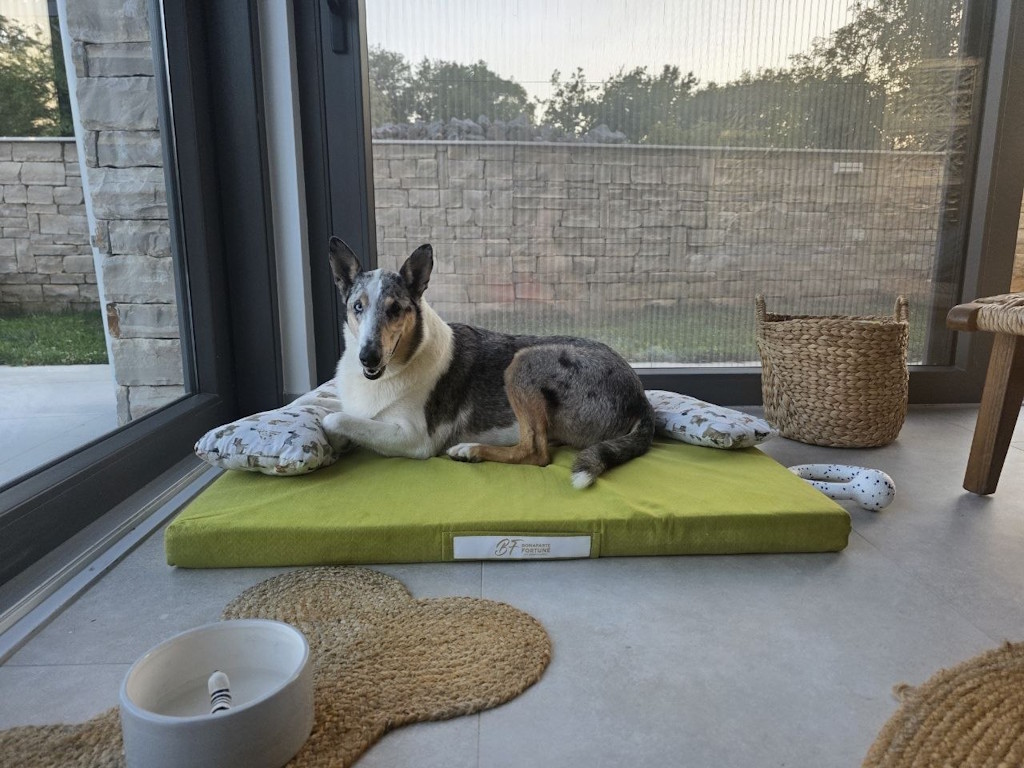
Instead of »hugging« the dog physically, we wanted to create a space that gives him freedom.
A space where he can completely stretch out.
Where they can change position without restriction.
Where she can choose how she wants to rest.
That is how our open dog bed design came to be. Not because we believed that a single shape is suitable for every dog, but because we wanted to give the freedom of movement as important a place as the feeling of comfort and security. That is our starting point.
At Bonaparte Fortuné, we believe that A good dog bed is one that allows them to rest in the way that suits them best, as only this enables that true R.E.M. sleep. 🐾
Some research has been done that has shown some very interesting connections.
Research Kis et al. (2017), published in Scientific Reports, has shown a link between sleep and the processes of learning and memory consolidation in dogs. The study Iotchev et al. (2017) further demonstrated the link between non-REM sleep characteristics and learning performance.
In a major study involving 1,330 dogs, the authors found a link between disturbed or shorter sleep and more frequently expressed behavioural problems.
Also of interest is the more recent research by Malkani et al. (2026),Assessment of the relationship between sleep and welfare in dogs using AWAG data, published in the magazine Discover Animals. The research analysed data from 77 dogs, whose owners estimated their sleep duration, and these were then compared with welfare scores based on the Animal Welfare Assessment Grid (AWAG).
Most interesting for our story:
- According to their owners, 62.3 % dogs slept for less than 14 hours a day.
- It was a shorter sleep statistically associated with a lower overall well-being score.
- There was a very strong link between poorer sleep and frequency fears, anxieties and frustrations (ρ = 0.92).
- There was also a moderate correlation with the response to stressors (ρ = 0.59).
For us, these findings were an important validation of the direction we were thinking in.
However, when developing the Bonaparte Fortuné, we did not want to simply follow the research. We continuously educate ourselves at home and abroad, keep up to date with new findings, observe our own dogs, and collaborate with veterinarians and therapists, learning from their experience. An important part of our development is also the experience of dog hotels, where our beds are regularly used and tested in everyday conditions.
All this enables us to ensure that ideas do not remain merely on paper, but are also tested in practice – with dogs of various sizes, ages and habits. It is precisely this combination research, expertise, experience and observation of dogs It became the basis for the development of the Bonaparte Fortuné.
We combined research, expert insights and our own observations to ask a simple question: If quality rest is so important for a dog – how can we create a space that will help them as much as possible?
We were asking ourselves simple yet important questions:
- Does the dog have enough space to fully stretch out while sleeping?
- Can he change his position without restrictions?
- Does the body have adequate support during rest?
- Is his bed comfortable enough for a prolonged rest?
- Is the mattress sufficiently protected against liquid ingress and able to offer a quality sleep for an animal suffering from incontinence?
- And is the sleeping area easy to keep clean?
We sought answers to all these questions – not to create just another dog bed. We wanted to create a space where a dog feels good. A space where they can retreat, relax, stretch out and simply switch off from the world for a while. A space that prepares them for their next adventure.
For when a dog sleeps, we require nothing from it.
It doesn't need to sit.
She doesn't need to wait.
He doesn't need to be good.
At that moment, they are simply resting. And perhaps that is precisely why it is not always necessary to look for complicated solutions.
Sometimes the most important thing for well-being is something very simple – enough space, good support and a quiet place where a dog can simply fall asleep. Because dogs don't need things to be complicated. Yet still something better than the sofa and the floor. We wanted to design simplicity in a way that makes sense. That is why we created a bed that follows the dog, instead of making the dog adapt to the bed – to its body, its movements and its way of resting.
Because for us, a dog bed is not just a piece of furniture.
And if we’ve managed to create a space where your dog can sleep just a little more relaxed, a little more comfortably and a little more on its own terms … then all the effort we’ve put into Bonaparte Fortuné has been worthwhile.
We wanted to add the finishing touch to the comfort
As we know how important cleanliness is in every home where animals live, we wanted to make maintaining their sleeping area as simple as possible. At the same time, we wanted the material in direct contact with their fur and skin to be as natural, pleasant and comfortable as possible.
That’s precisely why our beds also come with a choice of removable bed linen made from natural cotton that meets the OEKO-TEX standard. The bed linen can easily be removed, washed, freshened up and put back on – just like on our own beds. Because we believe our furry friends deserve the same thoughtful comfort that we want for ourselves. 🐾❤️
Check out our wide range of products here.
BETTER SLEEP. BETTER COMFORT. HAPPIER DOGS.
Thank you for trusting us ❤️
How did the brand get its name?
And why No one is allowed to name their dog Napoleon.

As the idea slowly developed, it came time to choose the right name for the brand of pet beds and bedding. We dithered over this for quite some time, as not every name exuded what the brand needed to communicate: added value for those pets who brought so much happiness, warmth, and joy into a human home, that their human owners gladly and lovingly give it back to them.
Whether it’s a delicious treat (even if that’s one too many for today), a little outfit to keep them warm, or a cosy, clean bed with charming designs that seem to say: ‘you little furball, you’re our greatest love’. The inspiration for the brand name thus stems from the touching yet true story of the famous Napoleonu, which tells us everything – that a furry little creature can soften even the hardest of hearts.
This is a summary of the true story of Napoleon and his encounters with dogs, as recounted by Stanley Coren, a professor of psychology, a neuropsychological researcher and an author on intelligence, mental abilities and the history of dogs.
Pug named Fortuné

Napoleon’s relationship with dogs was somewhat complex and not always positive. The first dog is said to have appeared in Napoleon’s life when he married Josephine. The young woman had a pug called Fortuné. Fortuné was a very easy-going and friendly little dog, but he spent a lot of time in her rooms.
However, when his mistress brought a man into her bedroom on her wedding night in 1796, an unfortunate incident occurred. Napoleon described his wedding night as follows – he pointed to the dog lying on the sofa and said: “Look at this gentleman – he is my rival. He was in my lady's bed on the day I married her. I wanted to remove him, but it made no sense now that I think about it. I was told to sleep elsewhere if I didn't intend to share the bed. This angered me greatly, but I had to make a decision. I resigned myself to sharing the bed. The favourite in the room, however, was not so hospitable...“
Napoleon went on to say that the newlyweds were embracing passionately, but little Fortuné simply couldn’t stand it and bit the naked general until he bled, leaving him with a scar.
Mascot and double victory

A few years later, Napoleon was reportedly symbolically humiliated by yet another dog. When the French navy was defeated by the British fleet at the Battle of Trafalgar, he was given a detailed account of the events. The account included the fact that a Newfoundland dog, who served as the mascot on the frigate HMS Nymph, was one of the first to board the French warship Cleopatra when it surrendered. Reports say that the general slammed his hand on the table and muttered: “Bugger! Do they have to beat me on the battlefield and in the bedroom?”
Another moving incident illustrates Napoleon’s attitude towards dogs; it took place on the night following the Battle of Bassano. Emmanuel, Count de Las Cases, was a French historian to whom Napoleon dictated his memoirs. He transcribed Napoleon’s recollection of the night following the Battle of Bassano during his Italian campaign.
Who turned the famous Napoleon inside out?

The general walked across the battlefield, strewn with the bodies of the fallen. He remembered: “We were alone, in the profound solitude of a beautiful moonlit night. Suddenly, a dog jumped out from under the cloak of a corpse. It ran towards us and then, almost immediately after, ran back to its dead master, howling sadly. It licked the soldier's lifeless face, then ran back to us – it repeated this several times. It was looking for help and revenge. I don't know if it was the mood of the moment, or the time, or what – the fact is, nothing I have seen on any other battlefield has made such an impression on me. I stopped, involuntarily, to reflect on this spectacle. Perhaps the fallen soldier had some friends in the camp – and here he lies, abandoned by all except his dog. What a lesson nature teaches us through an animal. How strange is man! How mysterious is the working of his sensibility! I have commanded in battles which were to decide the fate of entire armies, and have felt no emotions in doing so. I have seen the execution of manoeuvres which cost the lives of many of us, and my eyes have remained dry. And suddenly, I was shaken and turned inward by a dog howling in pain!”
Dog rescuer

It was in February 1815 that Napoleon decided to end his voluntary exile on the island of Elba. This move would eventually lead to his return to Paris. From there, events unfolded leading to his catastrophic defeat at Waterloo and his final retreat to the island of St Helena. All these events, which took place over 100 days, might never have come to pass had it not been for a misstep taken by Napoleon as he was leaving Elba.
Napoleon was getting ready to leave the island. As the boat pulled away, he stood by the railing and took one last look at the island. The boat was rocking and the surfaces were slippery. A few moments later, the sailors noticed that Napoleon was no longer in the boat – he had lost his balance and fallen into the sea. Unfortunately, the general was not a very good swimmer and, worse still, he was dressed in full uniform and carrying a large iron sword. He was drowning when a dog came to his rescue. The dog was a large black-and-white Newfoundland, which his owner, a fisherman, used to help pull ropes. The dog immediately swam over to Napoleon and kept his head above water long enough for the sailors to turn the boat round and pull him ashore. Napoleon continued on his way to his fate by boat, whilst his canine rescuer returned to his owner.
Symbol of loyalty

As a symbol of loyalty, Napoleon is said to have often thought of dogs. He once wrote: “If you dislike dogs, you dislike loyalty; you dislike those attached to you; and therefore, you are not loyal.” However, Napoleon still had mixed feelings about dogs, and they could still annoy him. As emperor, he had in fact decreed that no one was allowed to name their dog Napoleon.
Ultimately, Napoleon ended his life in forced exile on the island of Saint Helena. It is reported that he shared his exile with a black-and-white dog of an unknown breed named “Sambo”. The report states that the dog’s ears had been cropped in the Chinese style common at the time, which made its head look more like a seal’s than a dog’s. He often went for walks with the dog and seemed to truly adore him. Following Napoleon’s death in May 1821, Countess Françoise-Elisabeth Bertrand (the daughter of Josephine’s cousin) took the dog back to Europe, where he spent the rest of his life as a companion to her children.
A message from the Bonaparte Fortuné brand
What each person makes of this story is up to them. For the Bonaparte Fortuné brand, however, the story paints a picture of the magnificent significance of dogs in our lives. It shows just how much they teach us things that we humans have long since forgotten in the hustle and bustle of everyday life. They teach us love, attentiveness, to seek happiness in the little things, to find time for rest and fun, simply to be, without the frenzy of feeling that we must do something, that something is urgent, that we must always be rushing about …
Our mission is to operate with them in mind, who bring immense happiness into our home and enrich our lives. Our vision is not growth and market takeover; rather, we act with the motive of creating healthy comfort for our furry friends and bringing beautiful colours into your home, with which you can express how much you love your pet.
We do not want industrial production where products will fall off a conveyor belt, but rather we want to place quality, crafted by the hands of European workers, who work with love, and where their working environment is fair and safe, on the shelves. We would like to support and collaborate with organisations that claim that all sorts of furry friends, who do not have parents like you, live better lives and wait in a safe environment for their forever home, where they will sleep loved with full bellies.
With a vision embedded in the brand's DNA Bonaparte Fortuné We are delighted to present our carefully selected collection and hope it will absolutely captivate you. We hope you will find a wonderful gift for your “favourite person” that will also bring joy to you and bring the visual representation of the love you feel for them into your home.
A tribute to our beloved

Our Principles
Quality and safety
Our products are made from carefully selected materials that meet high standards of quality and safety – because we believe that a beautiful product must also be reliable and durable.
Fair production in the EU
We are committed to fair working conditions and local production within the EU. Each product is created with knowledge, respect, and responsibility towards the people who make them.
Durability and fewer unnecessary waste
We make products that last! And when it comes to packaging, we aim for the smallest environmental impact possible. We select solutions that are kinder to nature – we believe that small steps can lead to change.