

To start, let's clarify what we mean by a “puppy room”: this is a confined space within the home where the puppy has its own comfortable bed and fresh water. It makes sense to prepare the space so that it can be left open if the puppy is already used to it and enters it on its own when it needs to rest, or it can be closed so the puppy cannot get out during rest time. A puppy not yet accustomed to the space will know it's time to sleep, as there's no point in trying to escape to join the household activities. In any case, we recommend that every home with a puppy has a space for it that can be closed. This also does owners a favour, for example, when visitors arrive and we don't want the puppy to jump on them immediately, or when we have workers at home for renovations who are carrying heavy objects around and it would even be dangerous for the puppy to get under their feet, or perhaps a friend of our child is coming over who is afraid of dogs or is allergic to dog hair...
These are just a few scenarios where a puppy pen can also make the owner's life easier. Furthermore, such a space may be more important for your puppy's health than you think. This should always be a safe space, where we do not go during rest times and do not leave children in it, but rather leave the puppy to sleep peacefully. Finding safety and security is deeply ingrained in a puppy's DNA and significantly affects your dog's sleep. Quality sleep is the foundation of your puppy's overall well-being and behaviour, you can read more about this here. So if your dog doesn't yet have its own enclosed space in your home, or if you have any concerns regarding this, then please continue reading.
The most common reasons why people don't opt for a puppy pen:
- I want the puppy to be with the family all the time and not feel left out.
- I don't want to shut my puppy in, as he gets very sad and cries when he's shut in.
- Our dog most prefers to be with the whole family on the sofa; he doesn't want to go to his own bed.
- We don't have enough space at home to organise a dedicated spot for the puppy.
- When we're not home, we don't want our dog to be bored, so we leave them the run of the house.
- I don't know how to approach preparing the space, our puppy jumps over everything and wants to be with us all the time.
Are these valid reasons?
Of course, you want only the best for your dog, and it breaks your heart when he isn’t feeling well. But just as you know that it’s not best to give your dog spicy human food, even if they’re desperate for it, you need to realise that, whether you like it or not, your dog needs a quiet space to rest. If they’re in the same room as you or on the sofa, your dog will be on the alert the whole time; every move you make will wake them from their already light sleep. Your aim, however, is for your dog to sleep soundly for as long as possible. It’s worth emphasising here that only a dog that has been walked, has done its business and is ready to rest should be allowed into the sleeping area. The sleeping area should not be used to lock your dog away for long hours whilst you’re away. If you’re away from home for a long time and can’t find another solution, it’s still a good idea to let your dog move about, even if it’s just around the house or flat! Of course, you should first teach them not to chew on objects in the house – this will also be easier to do if you have a fenced-off area at home.
The most common reasons why you really should set up a fenced-off area for your dog
Creating an environment dedicated solely to your puppy significantly impacts your dog's mental health:
- Searching for small, cosy spaces is an instinct for your puppy
- Even a dog that is usually very calm and rarely loses its cool can be under stress and needs to be able to retreat
- Having a safe space can be useful in emergencies – for example, if a thorn gets stuck in your dog’s paw – this is where he’ll be most likely to trust you enough to let you carry out the “operation”
- For a young, playful puppy that doesn't know when to stop, a pen means playtime's over, where they can calm down and reset
- If your dog likes to chew on furniture or other items, this is the easiest way to protect your belongings, and the dog’s behaviour will eventually stop
- You might need the space if you have visitors who are afraid of dogs
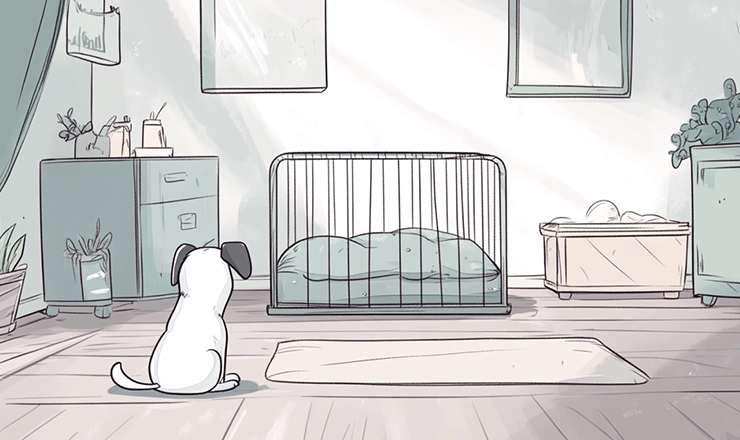
How can I help my dog get used to a new place?
Before you get a puppy
If you don’t have a puppy yet and are getting ready to welcome one into your home soon, you’re in a great position! Get the space ready before your canine friend arrives, and you won’t have any problems. When you enrol your puppy in training, you’ll already be one step ahead of the rest. Most training schools will tell you that a puppy needs a fenced-off area, as puppies find it hard to stop playing on their own, which – if left unchecked (time for a nap in a closed space!) – lead to rough play, which usually doesn’t end well and leaves you with a bite mark or a scratch from the dog’s teeth or claws. Not to mention chewed-up, destroyed items and your own frustration. All too often we hear stories like: “The children wanted a puppy, but now we adults are the ones dealing with it, because the children are afraid of it – it attacks and bites them all the time.” Or “Oh dear, we’re so embarrassed, you see, we’ve got a little puppy at home and that’s why the furniture’s in such a state; we’re waiting for him to grow up a bit, then we’ll have to replace the whole living room.”
A puppy is just like a small child: when it’s tired, it gets grumpy and can’t stop itself; it’ll carry on running about until it collapses, wherever in the house it happens to be. Every now and then, he gets a bit grumpy because things aren’t going his way, and then a chair leg or one of your shoes ends up bearing the brunt of it. A fenced-off area with a cosy dog bed will allow you to gently guide your pup to rest when you see that playtime is slowly getting out of hand. A dog that can’t go outside will sooner or later accept that it’s time for a sleep. It’s important, however, that you never use the room as a punishment! You need to recognise your dog’s behaviour and prevent them from doing anything you don’t like before it happens. For the first few weeks, guide them into the room with a really tasty treat and some kind words, so that your dog associates the room with pleasant feelings.
Don’t keep your dog shut in for hours on end; once he’s had a sleep, he’ll get up and wait for you. At that point, let him out and allow him to join in with what’s going on in your home, or take him out so he can do his business and have a walk. Later on, you may not even need to shut the room off anymore, nor will you need to supervise your puppy’s rest, as he’ll retreat there on his own when he’s tired or it all gets too much. If you travel with your puppy, make sure to read some advice here to find out how you can help your dog get a good night’s sleep when you’re on the move.
The puppy is still a young one
If your dog has been with you for some time and is used to moving about your home as he pleases and spending time with family members, it’s difficult to decide overnight to start confining him during rest periods from now on. If you’re already attending or planning to attend dog training classes, the trainers there will guide you on how to proceed correctly so that your dog gets used to the space as quickly as possible. There are various methods for this, but we swear by what we believe to be the quickest and most effective: set up a fenced-off area in your home; let the dog get used to the space for a few days without forcing him into it! then take the time to tire the puppy out much more than usual – for example, go for a long walk in the hills; if he likes playing with other dogs, take him to a dog park; throw a ball for him, …
Don’t give up until your dog has absolutely no desire left. At that point, take him home, give him something tasty to eat and gently guide him to his room. Is he still whingeing and whimpering, or trying to jump over the fence? Take him out again. And again, and again. You might have to back down. Repeat the exercise tomorrow; don’t give up and don’t get upset if it doesn’t work. If this method doesn’t work and you’re not attending dog training classes, book a few sessions with a dog trainer (even online) and discuss all your problems; they’re sure to share a few more tips that might just do the trick.
Adult dog
It will be more difficult to get an adult dog over 1.5 years old to get used to new rules. It also depends somewhat on the breed; small dogs that cannot jump over a fenced-off area will probably give in eventually, or they’ll use their barking to complain about the new regime. If your dog has its own bed, you’ll find this easier than owners of dogs that usually sleep on the human bed or on the sofa. Simply move the bed into the fenced-off area and leave the door open; perhaps your dog will go in on its own once it realises the bed has moved. Once they’ve got the hang of it, leave it at that – let them go into the area to sleep, and only close the gate when you really need to (visitors, tradespeople in the house, etc.). Every time he goes into the area on his own, reward him and give him some lovely, affectionate words so that he associates the space with positive feelings. If your dog sleeps with you on the bed or on the sofa and you’d like to change this, you’ll need to take it step by step.
First of all, set up a bed for your dog; you can read about how to choose the best dog bed here, then start by getting your puppy used to not sleeping in your bed. In the evening, when you go to bed, close your bedroom door and be patient if your puppy whines and scratches at the door (you can also place a barrier in front of the door to prevent it from getting scratched). If you don’t succeed on the first night, keep trying until you do – remember, all changes are much easier when your puppy is very, very tired; a longer walk or some more vigorous play might help you to be more successful. Once you’ve got the bed sorted, move on to the sofa. Place some barriers on the sofa; your dog will probably be a bit confused but will try to squeeze in somewhere, whilst you encourage him to use his bed. Place a treat on it, stroke your dog and use the commands they’ve learnt – ‘sit’, ‘lie down’. When they lie down, reward them again, give them a stroke, ….
Keep trying until you succeed, and if you do, you can then simply move the dog’s bed into the fenced-off area. If, after several attempts, you’ve had no luck and you really want your dog to sleep exclusively on its own bed, we advise you to book a few one-to-one sessions with a dog trainer, who, after assessing your dog, will be best placed to advise you on the quickest route to success. If you’re facing behavioural issues with your dog, don’t give up, as every bit of effort will pay off handsomely.
How do I set up a room for my dog?
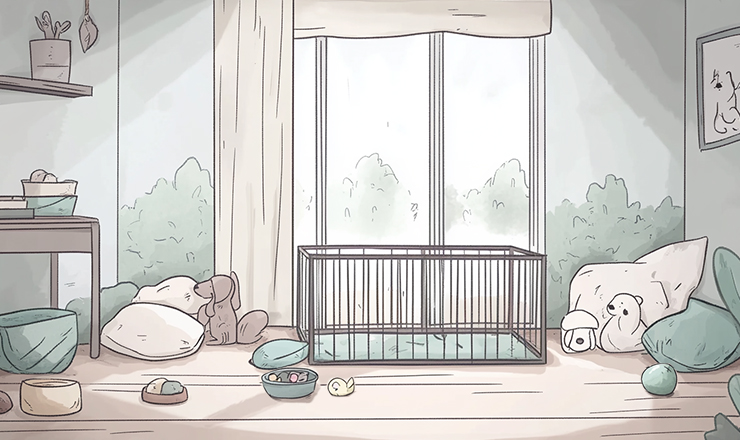
The easiest way to create a compact space that will last for years is to use playpens designed for toddlers, which you can buy online and in some shops specialising in baby and toddler products. You have complete freedom when setting up the space – you can buy as many playpens as you need, depending on the space you’ve set aside for your dog. It’s essential that the room has a dog bed, which you can choose based on the size of your dog here, have a water bowl, which should be fresh every day. If you also like to have fun with decorating yourself, you can arrange the puppy's room in a lovely style, on the wall (if there is one) you can stick some wallpaper or protect the wall with some cardboard (which you cover with gift wrap, there are a lot of designs available), you can also place a rug on the floor and, if the room is large enough, a box for dog toys and collars, so that you have everything in one place.
You might also find some ideas here.
Another option worth considering for smaller dogs is a crate; this won’t involve much effort – simply buy the right size and put a comfortable bed inside it. In our opinion, a crate in which a dog cannot move around at all or stand on its hind legs is unsuitable for confining the dog for long periods; and if you really have no other option, teach your dog to go into the crate on its own when it’s time to sleep, and leave the crate open. Your dog will prefer to rest at home without you anyway, but if they need to stretch their legs, they should be allowed to do so. After all, this is your beloved family member, and when you brought him into your home, you also took on the responsibility to act in the dog’s best interests.