
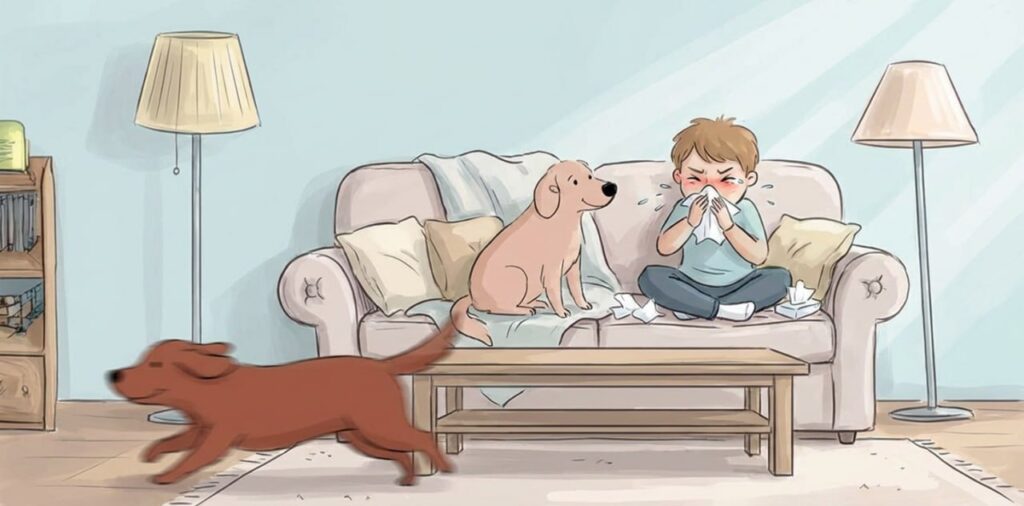
When a dog allergy appears in a family, a moment follows that none of us wants to experience: looking at the furry friend and quietly wondering if they will have to leave. The good news is, in the vast majority of cases, the answer is – NO. The bad news is, however, that some changes will be needed at home – especially where the dog spends most of its time.
In this post, we will look at two common scenarios: allergies in children and allergies that develop in an adult owner after years of living together. Both have a common point that many overlook – the dog bed.
First of all: what exactly are we allergic to?
In conversation, we say we're allergic to dogs, but it's not quite accurate. We rarely react to the dog itself. The real triggers are:
- mites, microscopic organisms that live in textiles and feed on dead skin flakes,
- animal dander, which is so light it floats in the air,
- dried saliva on fur, which transfers to hands and clothes during petting,
- mold in damp, poorly ventilated nooks of the home.
All this accumulates in textiles over weeks and months — carpets, curtains, upholstered furniture. But the highest concentration is always in one place: the dog's bed. This is warm, slightly damp from the body, and full of fur and skin flakes. For mites, this is the perfect environment, and for allergy sufferers, it's the strongest source of problems in the home.
Children and allergies: don't panic
Parents often think of the worst when their child sneezes for the first time. However, research shows the opposite of common belief: children who grow up with a dog develop allergies less often, not more often. Early contact with microorganisms and allergens teaches the immune system rather than overloading it.
How does an allergy typically manifest in a child? Most commonly as sneezing and a blocked nose when playing with a dog, itchy or watery eyes, scratching after contact with fur, and in more sensitive children, as rashes or a worsening of asthma. Symptoms are often milder in the morning after a night's sleep in a clean room and more pronounced after an afternoon spent on the floor with a furry friend.
If an allergy nevertheless appears in a child, this is therefore not a sign that the dog was the wrong decision. It is a sign that you need to proceed correctly, remove the dog from the bedrooms, and arrange its own bed where cleanliness needs to be regularly maintained. In practice, this primarily means the question: how often and how thoroughly can we wash the dog's bed?
This is where the difference between mattresses becomes apparent. Beds with non-removable covers, high soft edges, and numerous seams are a poor choice for a household with an allergy sufferer. The edges and pockets are difficult for a vacuum cleaner to access, washing the entire mattress is time-consuming, and dense filling often does not dry completely — and moisture provides another opportunity for mites and mould to thrive.
Simple, smooth shapes with a removable cover that can withstand washing at 60 °C are a significant advantage in a home like this. Only at this temperature can mites be reliably removed, not just surface dirt.
Adults: when allergies appear after years
The second scenario is even more confusing for many. You live with a dog for five, six, ten years without any problems – and then suddenly a blocked nose, itchy eyes, skin irritation appear. Is it possible to become allergic to your own dog?
Sadly, the answer is yes. An allergy isn't necessarily something we're born with. The immune system changes throughout life, and sensitivity can develop only after prolonged exposure. Contributing factors include the accumulation of allergens in the household over the years, periods of weakened immunity, other concurrent allergies, and even moving to an area with different air quality.
It's also important to know that a truly hypoallergenic breed doesn't actually exist. All breeds produce skin flakes and saliva; they just differ in the amount of hair they lose. Therefore, changing your dog isn't a solution either. The solution is control of allergens in the environment.
How to recognise if it's an allergy to dog allergens and not a common cold? Typical signs are that the symptoms mainly appear at home and not at work, that they worsen when cuddling or petting the dog, and that they improve when you are away from home without your pet for a few days. Of course, a visit to an allergist makes sense to confirm this.
Common denominator: the bed as a reservoir
The same rule applies to children and adults: the amount of allergens in the home is what we can control. And since the dog bed is the largest reservoir of these allergens, serious home hygiene starts right there.
Measures that make the biggest difference in practice:
- Change the clean mattress cover at least twice a week at 60 °C. This is the foundation — without it, all other measures are merely cosmetic.
- Spare cover. If you have two covers and rotate them, the mattress never remains unprotected, and washing doesn't have to wait for drying.
- Provide your furry friend with a bed that has the best possible core protection against liquid ingress. This is extremely important, as microorganisms that cause a multitude of problems thrive in moisture. Despite a well-protected core, occasional airing and drying of the dog bed's core is highly recommended.
- Vacuuming with a HEPA filter, at least once a week, with particular attention paid to the area around the bed.
- Regularly brush your dog, preferably outdoors, so that hair and skin flakes don't get into the flat at all.
- Restrict access to the bedroom and the owner's bed. The bedroom should remain the space with the fewest allergens, as we spend a third of the day there.
- Air purifier in the room where the dog sleeps, as additional support.
Why the shape of the mattress is not a minor detail
Many people are of the opinion that it's not important to pay special attention when choosing a dog bed. But that's precisely where the trap lies. If the bed is heavy, awkward to carry, and complicated to dismantle its layers, cleaning becomes difficult, and therefore we will do it more rarely. Hygiene that is strenuous simply won't happen in everyday life. When you have to cram the entire mattress into the washing machine and the edges take a long time to dry, sometimes so long that you are forced to offer your dog an alternative for a day or two, you'll do it reluctantly and too infrequently.
Therefore, when choosing a pet bed for a home with an allergy sufferer, we recommend three simple criteria: a removable cover, fabric that can withstand at least 60°C, and a smooth design without unnecessary edges, seams, and pockets where dust and fur can accumulate. Furthermore, dogs do not need complex, fluffy beds, which can ultimately also cause joint health problems.
At Bonaparte Fortuné all mattresses are designed precisely on these principles – with interchangeable covers that you can easily wash and replace, without unnecessary edges and seams where microbes could find shelter and exceptionally well-protected core before moisture ingress.
Perhaps the solution is just a step away…
An allergy in the family – whether in a child or an adult – is unpleasant, but it's not a reason to panic straight away, and in the vast majority of cases, it's not a reason to part with a pet. It's a signal that the environment needs more attention: regular washing, a thoughtfully chosen bed, and a few new habits. For many, new habits might sound like a lot of extra work, but in practice, such a routine is quickly established – you take off the cover, throw it in the washing machine, and put on a spare. Just as you would with your own bed, only it's all much simpler and easier. In return, you get a home where everyone can breathe: children, adults, and your furry friend.
A child and a dog can grow up together. The owner and the dog can stay together. Find out why more and more owners with allergies are opting for beds and bedding. Bonaparte Fortuné. If you still don't see this as a solution – you can return the purchased item within 30 days of purchase, and we will refund the full purchase price.